NEWS
May 21, 2026
Lifting Up Westchester and Caring for the Hungry & Homeless of Peekskill Form Strategic Partnership to Strengthen Services Across Westchester County
WESTCHESTER COUNTY, N.Y. — Lifting Up Westchester (LUW) and Caring for the Hungry & Homeless of Peekskill (CHHOP), two pillars of Westchester County’s social services and advocacy community, today announced a strategic partnership that merges their operational infrastructure while preserving each organization’s independent nonprofit status.
The partnership brings together two organizations with complementary geographic footprints. CHHOP primarily serves Northern Westchester while LUW focuses on Central and Southern Westchester. Together, they provide a continuum of services - including emergency shelter, permanent housing, food access, job readiness, youth mentorship, and homelessness prevention - that now spans the full length of the county.
By consolidating management, payroll, human resources, finance, and development functions, the partnership creates administrative efficiencies designed to direct more resources toward programs and the people they serve. The transition will be implemented in thoughtful phases, with programs and staffing remaining intact throughout.
The partnership has drawn support from Westchester County government.
“The alliance between Lifting Up Westchester and Caring for the Hungry & Homeless of Peekskill is exactly the kind of bold, forward-thinking collaboration that ensures our most vulnerable residents continue to receive the support they need. I’m proud to see these two organizations lead the way. Westchester County is stronger when our nonprofit community works together.”
— Ken Jenkins, Westchester County Executive
Board leadership from both organizations sees the partnership as a deliberate step toward greater regional impact.
“We are combining our infrastructure so that both organizations benefit from greater efficiency and shared strength, and our clients benefit from increased resources and more seamless regional coordination of services.”
— John A. Smith, Board Chair, CHHOP
LUW’s board echoes that view and emphasizes that the partnership opens new possibilities for advocacy and innovation on behalf of the people both organizations serve.
“During this era of shifting and uncertain funding, our united organizations will have more opportunities, more resources, and a greater ability to coordinate services, advocate, and innovate for the people who need us most.”
— Janine Simon Daughtry, Board President, LUW
The organizations are formalizing what has long been true in practice. Their missions, values, and commitment to the people served are deeply aligned. LUW and CHHOP have chosen a unique path, growing stronger together rather than competing. In a county of nearly one million people, where the margin between stability and crisis can be thin, that choice truly matters.
About Lifting Up Westchester (LUW)
Founded in 1979, LUW is a nonprofit organization providing life-changing support to people who have lost their housing or are struggling to meet their other basic needs. Each year, the organization partners with men, women, and children experiencing homelessness and hunger to build a more secure future for themselves and their families. For more information, please visit www.liftingupwestchester.org or connect with us on Facebook, Instagram, or LinkedIn.
About Caring for the Hungry & Homeless of Peekskill (CHHOP)
CHHOP’s ethos is that every person is entitled to safe, affordable housing and healthy, nutritious food. Since 1987, CHHOP’s work focuses on housing and food equity in Peekskill and the surrounding communities and supports people living with domestic violence, veterans experiencing homelessness, immigrants, people with mental health challenges, and other lower-income households. For more information, please visit www.CHHOP.org or connect with us on Facebook or Instagram.
NEWS
October 30, 2025
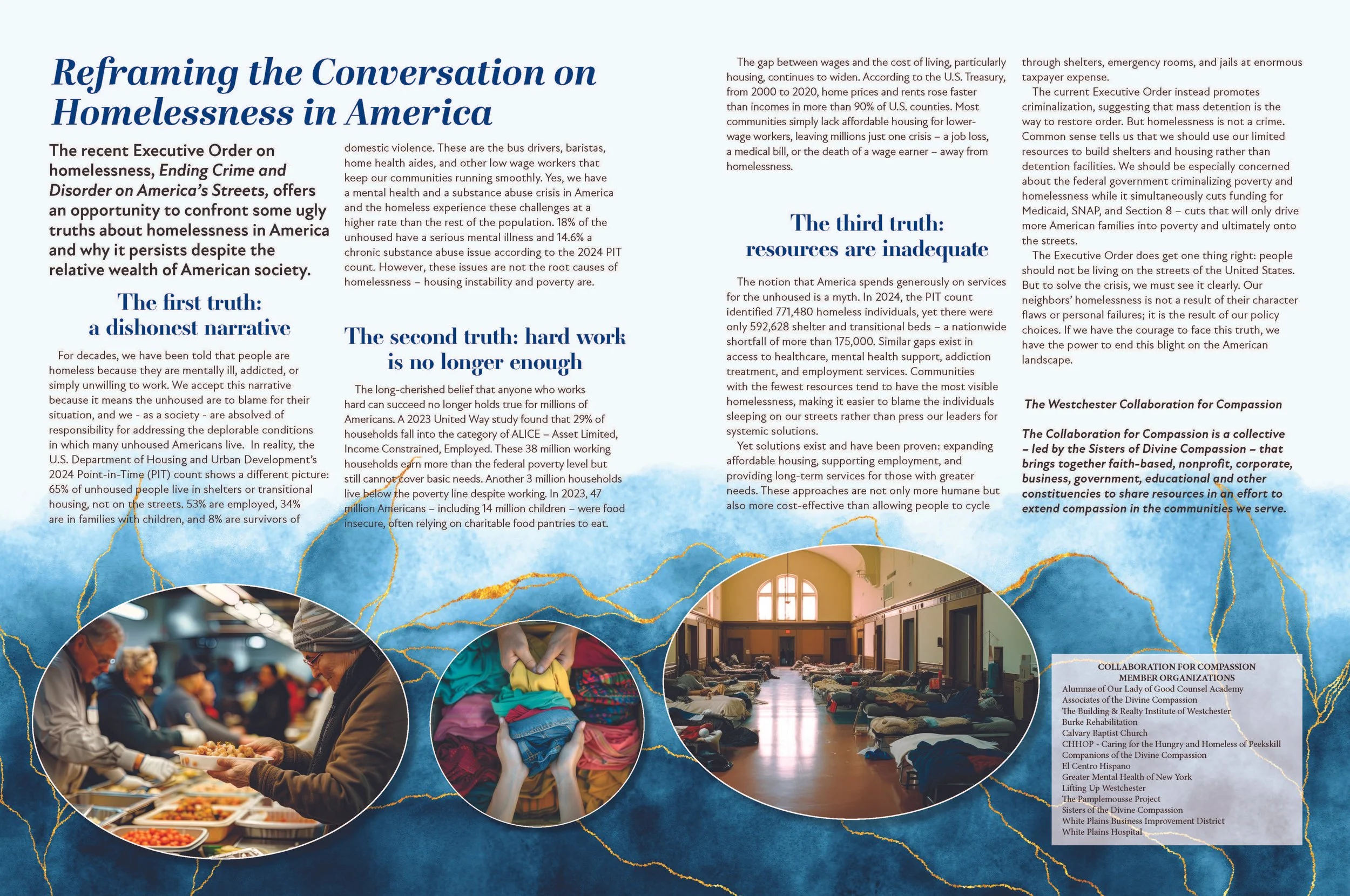
Reframing the Conversation on Homelessness in America
An Op-Ed by The Westchester Collaboration for Compassion
The recent Executive Order on homelessness, Ending Crime and Disorder on America’s Streets, offers an opportunity to confront some ugly truths about homelessness in America and why it persists despite the relative wealth of American society.
The First Truth: A Dishonest Narrative
For decades, we have been told that people are homeless because they are mentally ill, addicted, or simply unwilling to work. We accept this narrative because it means the unhoused are to blame for their situation, and we - as a society - are absolved of responsibility for addressing the deplorable conditions in which many unhoused Americans live. In reality, the U.S. Department of Housing and Urban Development’s 2024 Point-in-Time (PIT) count shows a different picture: 65% of unhoused people live in shelters or transitional housing, not on the streets. 53% are employed, 34% are in families with children, and 8% are survivors of domestic violence. These are the bus drivers, baristas, home health aides, and other low wage workers that keep our communities running smoothly. Yes, we have a mental health and a substance abuse crisis in America and the homeless experience these challenges at a higher rate than the rest of the population. 18% of the unhoused have a serious mental illness and 14.6% a chronic substance abuse issue according to the 2024 PIT count. However, these issues are not the root causes of homelessness – housing instability and poverty are.
The Second Truth: Hard Work Is No Longer Enough
The long-cherished belief that anyone who works hard can succeed no longer holds true for millions of Americans. A 2023 United Way study found that 29% of households fall into the category of ALICE – Asset Limited, Income Constrained, Employed. These 38 million working households earn more than the federal poverty level but still cannot cover basic needs. Another 3 million households live below the poverty line despite working. In 2023, 47 million Americans – including 14 million children – were food insecure, often relying on charitable food pantries to eat.
The gap between wages and the cost of living, particularly housing, continues to widen. According to the U.S. Treasury, from 2000 to 2020, home prices and rents rose faster than incomes in more than 90% of U.S. counties. Most communities simply lack affordable housing for lower-wage workers, leaving millions just one crisis – a job loss, a medical bill, or the death of a wage earner – away from homelessness.
The Third Truth: Resources Are Inadequate
The notion that America spends generously on services for the unhoused is a myth. In 2024, the PIT count identified 771,480 homeless individuals, yet there were only 592,628 shelter and transitional beds – a nationwide shortfall of more than 175,000. Similar gaps exist in access to healthcare, mental health support, addiction treatment, and employment services. Communities with the fewest resources tend to have the most visible homelessness, making it easier to blame the individuals sleeping on our streets rather than press our leaders for systemic solutions.
Yet solutions exist and have been proven: expanding affordable housing, supporting employment, and providing long-term services for those with greater needs. These approaches are not only more humane but also more cost-effective than allowing people to cycle through shelters, emergency rooms, and jails at enormous taxpayer expense.
The current Executive Order instead promotes criminalization, suggesting that mass detention is the way to restore order. But homelessness is not a crime. Common sense tells us that we should use our limited resources to build shelters and housing rather than detention facilities. We should be especially concerned about the federal government criminalizing poverty and homelessness while it simultaneously cuts funding for Medicaid, SNAP, and Section 8 – cuts that will only drive more American families into poverty and ultimately onto the streets.
The Executive Order does get one thing right: people should not be living on the streets of the United States. But to solve the crisis, we must see it clearly. Our neighbors’ homelessness is not a result of their character flaws or personal failures; it is the result of our policy choices. If we have the courage to face this truth, we have the power to end this blight on the American landscape.
The Westchester Collaboration for Compassion is a collective – led by the Sisters of Divine Compassion – that brings together faith-based, nonprofit, corporate, business, government, educational, and other constituencies to share resources in an effort to extend compassion in the communities we serve.
MEMBER ORGANIZATIONS
Alumnae of Our Lady of Good Counsel Academy
Associates of the Divine Compassion
The Building & Realty Institute of Westchester
Burke Rehabilitation
Calvary Baptist Church
CHHOP - Caring for the Hungry and Homeless of Peekskill
Companions of the Divine Compassion
El Centro Hispano
Greater Mental Health of New York
Lifting Up Westchester
The Pamplemousse Project
Sisters of the Divine Compassion
White Plains Business Improvement District
White Plains Hospital